
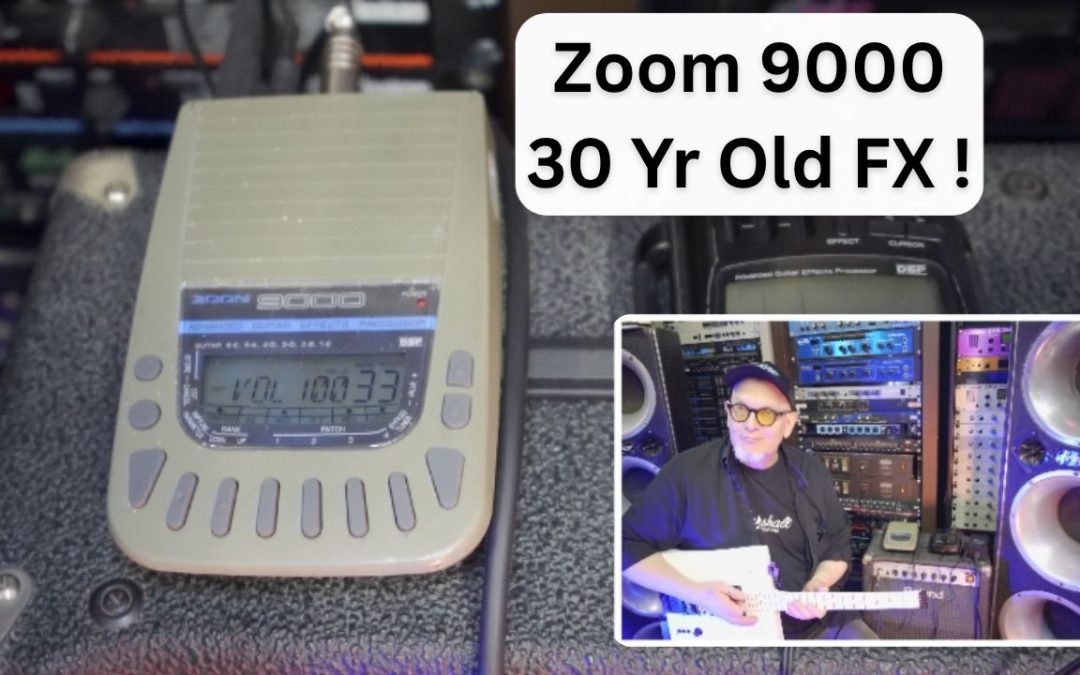
Zoom 9000 Review: A Forgotten Budget Multi-Effects Gem?
Is the Zoom 9000 the best cheap multi-effects pedal nobody talks about anymore? In this review, I put this vintage ’90s unit through its paces to see whether it still holds up in a modern home studio setup—and the results might surprise you.
Originally released during the early boom of affordable digital effects, the Zoom 9000 represented a shift in what guitarists could access on a budget. Built as a streamlined multi-effects processor and now long discontinued, it packed a wide range of sounds into a compact unit. Decades later, you can still pick one up for next to nothing—but does cheap still mean capable?
First Impressions
There’s something immediately nostalgic about the Zoom 9000. It comes from an era where multi-effects units were evolving fast, offering guitarists an all-in-one solution at a time when individual pedals were far less accessible.
Despite its age, the unit is surprisingly usable. The layout is simple, the workflow is fairly intuitive, and it’s clearly designed with practicality in mind—especially compared to some of today’s menu-heavy budget units.
Sound & Performance
At its core, the Zoom 9000 delivers a selection of essential effects, including:
-
- Reverbs and delays
- Modulation (chorus, flanger, tremolo, phaser)
- Drive tones ranging from clean compression to distortion
- Pitch shifting and EQ options
For a unit of its time, the sound quality is impressively solid. Early reviews noted its “usable” 16-bit digital effects and touch-sensitive distortion, which still hold up in certain contexts today.
That said, not everything has aged equally. Some effects feel dated or limited compared to modern plugins and pedals—but others still sit nicely in a mix, especially in lo-fi, indie, or experimental setups.
In a Modern Home Studio
So how does it perform today?
In a modern setup, the Zoom 9000 works best when used with intention. Running it through a clean amp or directly into an interface can yield surprisingly characterful tones. It won’t replace high-end modelling units, but it offers something different—an older digital flavour that can actually stand out in a mix.
Interestingly, some users still find that while certain sounds fall short, others “still stack up” even after 30 years.
Strengths & Limitations
What works well
-
- Cheap and widely available on the used market
- Simple signal chain and routing
- Unique vintage digital character
- Some effects still genuinely usable
Where it struggles
-
- Limited editing compared to modern units
- Some effects sound dated
- No modern connectivity or flexibility
- Build and UI feel very “of its time”
Final Verdict
The Zoom 9000 isn’t a hidden miracle pedal—but it is a fascinating piece of gear history that still has its place.
If you’re expecting a modern all-in-one solution, you’ll be disappointed. But if you’re after character, experimentation, or a budget-friendly way to add something different to your setup, this overlooked ’90s unit might be more relevant than you think.
Sometimes, cheap doesn’t mean outdated—it just means misunderstood.